



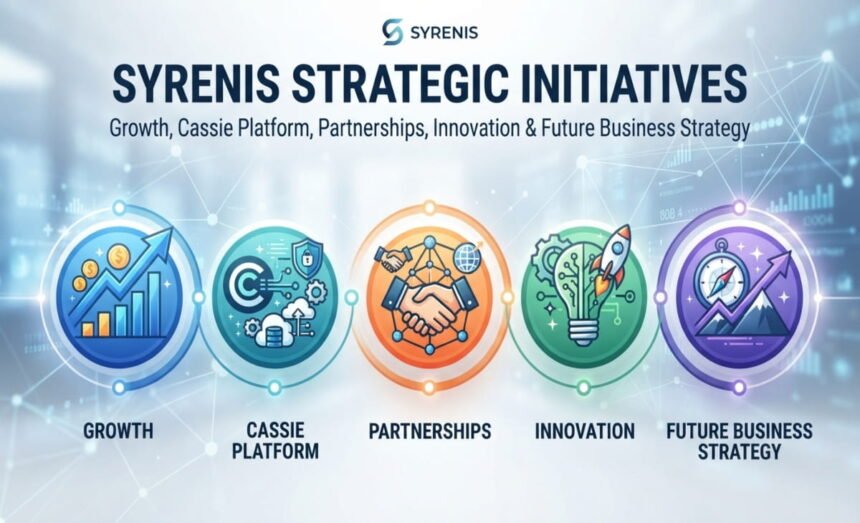
Syrenis strategic initiatives center on helping large organizations manage customer consent, privacy preferences, and permission data more effectively. At the same time, the company’s broader strategy involves commercial growth, technology development, strategic partnerships, enterprise expansion, and a stronger presence in the United States.
These initiatives matter because large businesses often operate many websites, applications, marketing platforms, databases, and customer-facing systems. A privacy decision made through one channel may need to be recognized throughout the rest of the organization.
Syrenis approaches this challenge through its consent and preference management technology, particularly the Cassie platform. Its wider strategy also includes integrations, consulting relationships, enterprise sales, and expanding its reach into international markets.
This article explains Syrenis strategic initiatives, the Cassie platform, its approach to enterprise growth, major partnerships, integrations, privacy management, and potential future developments.
What Are Syrenis Strategic Initiatives?
Syrenis strategic initiatives refer to the company’s plans for expanding its business while developing technology that helps organizations manage customer consent and preferences.
The available information points to several important areas, including international expansion, enterprise sales, product development, partnerships, technology integrations, and improved privacy experiences.
The underlying business problem is relatively straightforward. Large companies can collect customer preferences through many different channels. A person might provide marketing consent through a website and later change that decision through an app, email preference center, or customer service interaction.
If those systems are not synchronized, different parts of the organization may hold conflicting information.
For example, one system could indicate that a customer has opted in while another could still show an older opt-out or outdated preference.
Syrenis aims to address this issue by connecting consent and preference information so that businesses can maintain a more consistent record of customer choices.
Its approach extends beyond the basic cookie-consent experience. Consent can become part of the broader customer data infrastructure used by privacy, legal, marketing, technology, and data teams.
The wider objective is to make privacy choices easier to capture, update, apply, and demonstrate when necessary.
Syrenis and the Cassie Platform
Cassie is Syrenis’s consent and preference management platform. It is designed for organizations that need to manage customer permissions across multiple systems, brands, countries, and communication channels.
Businesses can use Cassie to collect and maintain consent information and customer preferences.
For instance, a customer may choose whether they want promotional emails, select particular subjects they are interested in, or determine how a company should communicate with them.
However, collecting the initial preference is only part of the challenge.
Once the customer makes a choice, that information needs to reach the other systems that rely on customer data. If the person later changes or withdraws permission, the updated decision should also reach the appropriate connected systems.
Cassie is designed to support this type of enterprise-wide consent management.
The platform can also maintain records showing what a customer agreed to and when the decision occurred. Time-based records can be useful when an organization needs to understand the history of a permission or review how consent was obtained and managed.
Preference management is another important component.
Instead of limiting customers to a basic subscribe-or-unsubscribe decision, organizations can provide more detailed choices. Customers might be able to select communication channels, topics, or other preferences.
This makes the platform relevant not only to privacy teams but also to marketing, customer service, technology, data, and related business functions.
Creating a Single Source of Truth
A major concept within Syrenis strategic initiatives is the creation of a centralized and trusted source for customer consent and preferences.
Large organizations frequently maintain customer information in numerous systems.
An email marketing platform may contain communication preferences. A website may hold cookie choices. A CRM can contain customer information, while mobile applications, customer service systems, and other channels may capture additional decisions.
When these records fail to stay synchronized, problems can occur.
Consider a customer who unsubscribes from marketing through one service. If another marketing platform does not receive the updated information, the business could continue contacting that customer.
A centralized consent record is intended to reduce this type of inconsistency.
When a customer creates or changes a preference, connected systems can receive the latest information. This gives different teams a more consistent understanding of what the individual has permitted.
Centralized records can also support privacy reviews and audits.
An organization may need to establish when consent was obtained, what the customer agreed to, and whether that permission was later modified or withdrawn.
A centralized consent system does not eliminate the need for privacy policies, security procedures, legal assessments, or appropriate governance. It can, however, make the management of these responsibilities more organized.
Global Growth and U.S. Expansion
International growth is another major element of Syrenis strategic initiatives.
Syrenis works with enterprise organizations that can operate across multiple countries and legal environments. Companies with customers in different regions need systems capable of handling privacy requirements within complex operating structures.
The collected information identifies Syrenis locations in Daresbury in the United Kingdom and Austin and Atlanta in the United States.
The U.S. market is particularly significant because privacy regulations can vary from state to state.
California, for example, has major privacy legislation including the California Consumer Privacy Act and California Privacy Rights Act. Other states have developed their own privacy frameworks.
For organizations serving customers throughout the country, this can make privacy management more complicated.
A single company may have millions of customers while needing to account for different regulatory obligations depending on where those customers are located.
A stronger presence in the United States can therefore place Syrenis closer to enterprise customers and business partners dealing with these challenges.
The available information also associates its U.S. activities with industries such as finance, healthcare, retail, media, and technology.
These sectors can process substantial amounts of customer information and may have sophisticated consent and privacy requirements.
Enterprise Sales and Growth Strategy
Selling privacy software to large organizations is different from selling a simple consumer application.
Enterprise technology purchases often involve several internal teams.
Privacy and legal departments may examine regulatory and compliance requirements. Security and IT teams may assess integrations and infrastructure. Marketing and data teams may evaluate how customer preferences can be used.
Because of this, enterprise software sales and implementation can take considerable time.
The collected information indicates that Syrenis has strengthened its commercial leadership with people experienced in software-as-a-service and business development.
Its reported commercial priorities include international expansion, growth in the United States, increased sales opportunities, and efforts to reduce the length of enterprise sales cycles.
These goals connect directly with the wider Syrenis strategy.
Securing a major enterprise customer is not enough by itself. The technology also needs to integrate with existing systems and support the organization’s privacy processes.
As a result, enterprise growth is closely connected to Syrenis’s product development, integrations, and partnership strategy.
Strategic Partnerships
Partnerships with privacy specialists and consulting organizations also form part of Syrenis strategic initiatives.
Consent software is only one component of an enterprise privacy program.
Organizations may also require assistance with privacy policies, regulatory interpretation, data mapping, implementation, employee education, and the design of customer-facing privacy experiences.
A technology provider can supply the consent infrastructure while consulting partners contribute specialist knowledge and implementation support.
This combination can be particularly valuable for large organizations where privacy changes affect many departments and technology systems.
The Data Privacy Group
Syrenis announced an alliance with The Data Privacy Group (DPG) in August 2025.
The relationship combines Syrenis technology with DPG’s privacy consulting capabilities. The reported initial focus included organizations across the United Kingdom, Europe, and North America.
The two organizations can contribute different capabilities to a privacy project.
DPG can assist organizations with understanding and developing their privacy programs, while Syrenis technology can help implement consent and preference requirements across connected business systems.
This type of arrangement can be useful for companies that require both specialist privacy advice and supporting technology.
KPMG Collaboration
The collected information also describes work involving Syrenis and KPMG.
According to the material, Syrenis developed a dedicated KPMG resource hub after a workshop and product demonstration.
The resources discuss how implementation partners can help organizations gain greater value from consent management.
Related subjects include progressive profiling and approaches for evaluating the business value of consent programs.
It is important, however, not to interpret this information as proof of a broad formal relationship covering every KPMG organization or service.
The exact scope should be understood according to the particular collaboration and resources that have been made available.
Myna
The supplied material also describes a relationship between Syrenis and Myna, identified as a U.S.-based privacy consulting company.
The relationship is presented as another example of connecting privacy strategy with practical enterprise implementation.
This fits with Syrenis’s broader partnership model of combining consent technology with specialized privacy expertise.
However, detailed information about the exact terms and scope of the Myna relationship is limited in the available material.
For that reason, broader claims about the partnership should be avoided unless additional supporting information becomes available.
Integrations and Connected Privacy Data
Consent information becomes more useful when it can communicate with the technology that a business already operates.
Large companies may use CRM platforms, email marketing systems, analytics software, customer-service applications, and many other marketing and data tools.
These systems need access to current customer decisions.
Syrenis reports that its platform supports more than 350 integrations, allowing consent and preference information to connect with other business applications.
For example, if a customer changes an email preference, the relevant marketing system needs to receive that change before another campaign is sent.
Pre-built connectors can simplify certain integrations, while flexible data mapping can help businesses align consent information with their existing data structures.
Real-time or timely synchronization is important because customer preferences can change at any point.
The goal is to ensure that connected systems operate using the most recent available customer decision.
This approach may also allow companies to retain existing technology rather than replacing every system. A consent management layer can sit across the existing technology environment and provide a common source of preference information.
Because integrations can change over time, organizations should confirm current compatibility with Syrenis before beginning an implementation.
Cross-Domain Consent
Large enterprises frequently operate several websites, brands, online stores, portals, or digital services.
Managing consent across these properties can become difficult if customers are repeatedly asked to make the same privacy decisions.
Syrenis offers Cross Domain Consent to address this type of situation.
Based on the supplied information, the feature is intended to allow consent choices to be recognized across approved connected domains.
For example, an organization operating several related websites may be able to recognize a visitor’s existing consent decision on another connected website where the technical setup and applicable privacy rules permit it.
This can reduce repetitive consent prompts and help limit what is commonly called consent fatigue.
Cross-domain consent still requires appropriate configuration.
Different websites may process different information, serve different purposes, use different technologies, or operate under different legal requirements.
Therefore, transferring a consent decision between domains does not remove an organization’s wider privacy responsibilities.
Enterprise Scale and Performance
Enterprise consent systems can be required to handle very large quantities of information.
A global company may have millions of customers, each with multiple consent records and preferences. Those records can also change repeatedly throughout the customer relationship.
The supplied material reports that Syrenis technology has supported clients involving as many as 350 million data subjects.
It also reports a capacity of up to 50,000 record requests per second.
These numbers should be regarded as reported platform claims unless they are confirmed through current technical documentation or other primary evidence.
Performance is important because consent changes may need to reach several systems quickly.
If a customer withdraws permission, delays in communicating that change to connected platforms can create operational and privacy concerns.
Large enterprises therefore require more than a consent interface. They also need infrastructure capable of storing, processing, and distributing preference information reliably.
Preference Centers and Progressive Profiling
Another area within Syrenis strategic initiatives is giving customers greater control over their preferences.
A preference center provides a dedicated place where customers can manage their choices.
Rather than forcing someone to subscribe to everything or unsubscribe from all communications, an organization can allow more detailed decisions.
Depending on how the system is configured, customers may be able to choose communication topics, channels, or other relevant preferences.
Syrenis also supports progressive profiling.
Progressive profiling involves collecting useful customer information gradually instead of asking for a large amount of information during the first interaction.
A business can request additional information later when there is a relevant reason to do so.
This can make forms easier to complete and may help companies develop more useful first-party customer profiles.
It can also give customers clearer control over which information they choose to provide.
Privacy-Led Marketing and First-Party Data
Marketing is another important area connected to Syrenis strategic initiatives.
Businesses want to understand their customers and communicate with them effectively, but they also need to respect customer choices and applicable privacy requirements.
Accurate consent and preference information can help marketing teams determine how customers want to be contacted.
First-party data refers to information that an organization collects directly through its relationship with customers.
Preference centers and progressive profiling can support the collection of this information in a more controlled way.
For example, customers might select the subjects they want to hear about or identify their preferred communication channels.
Marketing teams can then use those stated preferences when developing communications.
This can reduce irrelevant messaging while making customer information more useful.
However, implementing consent software does not automatically make every data-processing activity lawful.
Organizations still need to determine the appropriate legal basis, purpose, permissions, and privacy obligations for each activity.
AI Governance and Consent Data
Artificial intelligence introduces another potential application for well-managed consent information.
Organizations using customer information with AI systems need to understand where that information originated and whether it can legally and appropriately be used for the intended purpose.
Reliable consent records can help organizations answer some of these questions.
The supplied information presents Syrenis consent records as potentially useful within AI governance.
Such records may include information about the purpose associated with a choice, the relevant customer, timestamps, and changes to permission.
For example, an organization may need to determine whether certain customer data can be used for a particular AI-related purpose.
A clear consent history can provide evidence that is useful during such an assessment.
There are important limits, however.
Consent management represents only one component of AI governance.
Organizations may also require security controls, access management, model testing, risk assessments, internal policies, legal reviews, and human oversight.
Syrenis can therefore provide a consent and preference layer, but it does not constitute a complete AI governance framework on its own.
Benefits for Enterprise Organizations
The potential benefits of Syrenis strategic initiatives largely come from organizing privacy information and making it available across connected enterprise systems.
For large organizations, potential advantages include:
- One centralized location for consent and preference records.
- More consistent customer choices across connected applications.
- Stronger records for privacy reviews and audits.
- Improved coordination among privacy, legal, marketing, technology, and data teams.
- Support for preference centers and first-party data strategies.
- Reduced unwanted communication when preferences are correctly applied.
- Connections with existing enterprise technology.
- Support for large quantities of consent information.
- More useful records for certain AI governance and data-use assessments.
The actual results depend on how the technology is implemented and connected to the organization’s systems.
Software by itself cannot correct poor data management, weak governance, or an incomplete privacy program.
Challenges and Limitations
Enterprise consent management can involve substantial implementation challenges.
Integration is one major consideration.
Large organizations may operate a mixture of legacy applications and modern cloud services. Customer information may exist in different formats and may use different identifiers across systems.
Connecting these environments can require extensive planning, data mapping, testing, and technical resources.
Privacy regulations create another challenge.
International businesses can face different requirements depending on the country, state, customer, type of data, and processing purpose.
A consent platform can help organize customer decisions, but organizations remain responsible for determining which legal obligations apply.
Partnership arrangements also require clear responsibilities.
When a software company and outside consulting firms participate in the same privacy project, each party needs a well-defined role.
Data synchronization requires continuing oversight as well. An integration is useful only when updates consistently reach the appropriate systems.
AI creates additional limitations.
A consent record may help establish whether a person permitted a particular use of their information, but it cannot by itself resolve every issue involving AI fairness, security, safety, governance, or regulatory compliance.
Finally, some scale and performance numbers in the available material are company or platform claims.
Enterprise buyers should therefore review current technical documentation and compare the platform’s capabilities with their own requirements.
Future of Syrenis Strategic Initiatives
The available information suggests that Syrenis is positioning consent management as a broader component of enterprise data infrastructure.
International expansion can help the company reach more large organizations. Consulting relationships can provide additional expertise for privacy planning and implementation.
Expanding integrations can also make consent and preference information accessible throughout a larger technology environment.
AI governance could create additional demand for detailed consent records as organizations pay greater attention to the origin of their data and the purposes for which it can be used.
The success of these initiatives will depend on practical execution.
Syrenis needs to maintain scalable technology, straightforward integrations, and clear audit capabilities. Its connected systems must also continue to transmit customer choices accurately as information moves across an organization’s technology stack.
Privacy regulations and technology will continue to evolve.
As a result, consent and preference management platforms will need to adapt regularly to changing legal, technical, and business requirements.
Bottom Line
Syrenis strategic initiatives combine commercial expansion with technology designed to manage customer consent and preferences.
The company’s strategy includes U.S. and international growth, enterprise sales, consulting relationships, integrations, preference management, first-party data, and potential applications in AI governance.
At the center of this approach is the idea of maintaining customer choices in a trusted system and distributing those choices to the business applications that depend on them.
For large enterprises, this can make privacy information easier to manage across websites, marketing systems, CRM platforms, and other technology.
However, successful implementation still depends on appropriate configuration, integrations, security practices, internal policies, and legal oversight.
Frequently Asked Questions
What are Syrenis strategic initiatives?
Syrenis strategic initiatives refer to the company’s efforts involving business growth, privacy technology, partnerships, integrations, international expansion, and consent management.
What is Syrenis?
Syrenis is a technology company focused on helping organizations manage customer consent, privacy choices, and preferences.
What is Cassie?
Cassie is Syrenis’s consent and preference management platform. It is designed to help organizations manage customer choices across different systems and channels.
What does a single source of truth for consent mean?
It means maintaining customer consent and preference information in one trusted location so that connected systems can work from consistent and current information.
Does Syrenis integrate with other business systems?
Yes. Syrenis connects consent and preference information with CRM, marketing, analytics, and other enterprise systems. The company reports supporting more than 350 integrations.
What is Cross Domain Consent?
Cross Domain Consent is designed to allow customer consent choices to work across approved connected websites, potentially reducing the need for users to repeatedly provide the same choice.
How does Syrenis support first-party data?
Syrenis supports tools such as consent records, preference centers, and progressive profiling, which can help organizations collect information directly from customers while respecting their stated preferences.
Can Syrenis support AI governance?
Consent records can contribute to understanding how customer information may be used, including the purposes associated with permissions. However, AI governance also requires security, legal, risk-management, and other controls.