



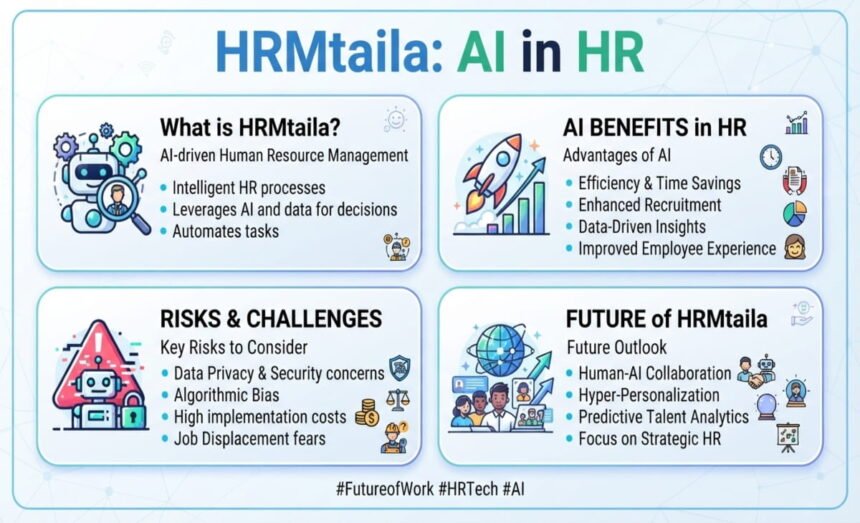
HRMtaila is an emerging online term associated with artificial intelligence and human resource management. Recent online discussions use the word in connection with AI-powered recruitment, HR automation, employee assistance, workforce analytics, and other digital HR activities.
However, HRMtaila has not been reliably established as a recognized software platform, company, or official HR technology standard. Its precise origin and the identity of whoever may have introduced the term are also unclear.
This article explains what HRMtaila currently appears to mean based on the available information. It also explores how artificial intelligence is being used across recruitment, onboarding, employee support, workforce planning, payroll, performance management, and other areas of human resources.
What is HRMtaila?
HRMtaila does not currently have one officially recognized definition. Online articles generally use the term in connection with AI-powered human resource management.
Under this interpretation, HRMtaila brings together ideas such as artificial intelligence, HR automation, cloud-based HR software, and workforce analytics.
The basic concept is straightforward. HR departments manage many repetitive activities, including job applications, employee records, onboarding, leave, payroll information, training, reporting, and employee questions.
Modern technology can help with some of these responsibilities.
For example, software can organize applications, send reminders, prepare reports, manage information, or respond to common employee questions. Automation can reduce repetitive administrative work and allow HR professionals to spend more time on tasks that require human judgment.
It is important, however, to distinguish between general AI applications in human resources and confirmed HRMtaila features. There is currently no established HRMtaila product whose capabilities can be independently verified.
Is HRMtaila a Real HR Platform?
There is currently insufficient reliable information to describe HRMtaila as an established commercial HR software platform.
No confirmed company, developer, or organization has been publicly identified as the creator of HRMtaila. There is also no reliably established founder, CEO, headquarters, customer base, or documented product history.
Important commercial details are similarly unavailable. There are no confirmed HRMtaila pricing plans, subscription packages, official mobile applications, integrations, system requirements, or clearly documented free and paid versions.
The origin of the name is also uncertain. The abbreviation HRM can naturally be understood as “human resource management,” while some online references associate the remainder of the term with technology or artificial intelligence.
However, no verified creator has publicly explained the complete meaning of the name.
The fact that several websites use similar descriptions does not make those descriptions official. Online articles can repeat information from one another without independent confirmation.
For now, HRMtaila is best understood as an emerging online keyword connected with AI and HR technology rather than as the confirmed name of a commercial software product.
How AI Is Changing Human Resource Management
Human resource technology has existed for many years. Traditional HR systems can store information such as employee names, job roles, attendance, leave, salary details, employment records, and other workplace data.
Artificial intelligence adds additional ways of working with this information.
Modern HR technology can process large quantities of data, identify patterns, automate routine activities, generate reports, and answer certain common questions.
For example, an HR department might use software to organize job applications or schedule interviews. Another system could guide new employees through onboarding tasks. An AI assistant might answer a basic question about company policies or leave.
The purpose is generally not to eliminate HR professionals. Instead, automation can reduce repetitive administrative work.
People remain essential because many HR decisions require context, communication, and judgment. Hiring, workplace disputes, performance reviews, compensation decisions, and employee relations cannot always be handled accurately by analyzing data alone.
AI in Recruitment
Recruitment is one of the areas where artificial intelligence and automation can provide significant administrative support.
A company may receive hundreds of applications for a single position. Reviewing and organizing all of those applications manually can require considerable time.
AI tools can help process recruitment information more efficiently.
For example, software may organize CVs, identify skills mentioned by applicants, and compare candidate information with job requirements. It can also help keep applications organized and maintain recruitment records.
AI may assist with other routine recruitment activities as well. It can help create job-description drafts, schedule interviews, send reminders, and provide basic updates to candidates.
These tools can make the early stages of hiring more efficient. However, automated results still require human review.
A candidate may have valuable experience that does not match the exact keywords expected by an automated system. A numerical score can also fail to capture relevant personal or professional context.
For this reason, qualified people should remain involved in important hiring decisions. AI can organize and analyze information, but it should not automatically become the final authority on whether a person is suitable for a position.
AI in Employee Onboarding
Onboarding begins when a new employee joins an organization. The process can involve numerous tasks during the employee’s first days or weeks.
New workers may need to submit documents, create accounts, review company policies, complete training, learn about benefits, and receive access to workplace systems.
Automation can organize these activities into a structured process.
For example, a digital HR system can provide a new employee with a list of required tasks and indicate which activities have been completed. It can send reminders about unfinished paperwork or training and provide links to relevant policies.
AI assistants can also answer straightforward onboarding questions. An employee might ask where a particular form is located or how to access a training resource.
This can be particularly useful for remote organizations and companies with employees working across different time zones. Basic information can remain accessible even when an HR professional is unavailable.
However, onboarding should not become entirely dependent on automation. Employees should always have a clear way to contact a real HR representative when they encounter a sensitive issue, unusual situation, or question that an automated system cannot handle.
AI Chatbots and Employee Support
HR departments frequently receive similar questions from employees.
Workers may want information about vacation or leave policies, pay dates, benefits, training programs, company rules, or internal forms.
An AI chatbot or virtual HR assistant can potentially answer some of these routine questions.
This can give employees quicker access to basic information. Instead of waiting for an email response, a worker may be able to receive an answer immediately.
It can also reduce repetitive workloads for HR professionals. They can devote more attention to employee concerns that require personal communication.
However, AI should not be responsible for every employee issue.
Workplace complaints, conflicts, complicated payroll concerns, disciplinary matters, and sensitive personal situations may require careful human discussion. A chatbot may lack the context necessary to understand the full circumstances.
Employees should therefore always have access to a real HR professional when automated support is insufficient.
Workforce Analytics and Planning
HR departments collect many forms of workforce information. This can include employee turnover, attendance, hiring times, skills, training, leave, labor costs, and staffing levels.
Workforce analytics involves examining this information to understand what is happening within an organization.
AI can process large amounts of workforce data and identify patterns that may be difficult to spot manually.
For instance, data could indicate unusually high employee turnover in one department. It might also reveal a shortage of particular skills or suggest that additional staff could be needed in a certain area.
Such information can help organizations plan future hiring, training, and staffing requirements.
Predictive analytics may also identify patterns that could indicate future workforce problems. However, a prediction should not be treated as a confirmed fact.
If employees are leaving one department at a higher rate, for example, the data does not automatically explain why. Possible causes could include management practices, workload, compensation, career opportunities, or other workplace factors.
Managers still need to investigate the underlying situation and communicate with employees. Workforce analytics should support human decision-making rather than replace it.
Payroll, Records, and HR Automation
HR departments handle many administrative responsibilities involving employee records.
These records can include attendance, leave, overtime, salary information, documents, and other employment details. Manually entering the same information into several systems can take time and create opportunities for errors.
Automation can help transfer information between connected systems and organize employee records. It may also flag missing information or unusual entries so that a person can investigate them.
Payroll is another area where automation can assist. Attendance, leave, overtime, and salary information can be brought together to support payroll processing.
Cloud-based HR systems can also store important employee records in a central location. Access controls can determine which employees and managers are permitted to view sensitive information.
Automation does not guarantee perfect results. Incorrect information can still produce incorrect payroll or employee records, so organizations need appropriate checks and human oversight.
These are examples of general HR technology applications. They should not be presented as confirmed features of HRMtaila because there is currently no verified HRMtaila software product offering them.
AI in Performance Management
Performance management can involve employee goals, work results, manager evaluations, feedback, and professional development.
AI can help organize this information and make it easier for managers to review performance-related data.
For example, a system could bring together employee goals, project outcomes, and feedback in one location. This may help managers identify areas where additional training or support could be useful.
However, employee performance cannot always be accurately represented by numbers.
Data may fail to capture a difficult project, changing responsibilities, unusual workloads, team problems, or other circumstances affecting an employee’s results.
Managers should therefore treat AI-generated information as one source of evidence rather than the final judgment.
Important performance decisions should involve direct communication with employees and appropriate human review, particularly when the outcome could affect compensation, promotion, disciplinary action, or employment.
Benefits of AI in HR
Artificial intelligence and automation can provide several potential advantages when applied to appropriate HR tasks.
One major benefit is time savings. Software can handle repetitive activities such as organizing information, sending reminders, preparing basic reports, and answering routine questions.
Automation can also make certain processes more consistent. The same workflow can be followed repeatedly, helping organizations track tasks and potentially reducing simple administrative errors.
Employees may also receive faster access to basic information. A digital HR assistant, for example, could answer a routine question without requiring the worker to wait for a manual response.
Workforce analytics can provide HR teams with useful information about hiring, turnover, skills, attendance, and staffing patterns. This information can support workforce planning.
Perhaps most importantly, reducing routine administrative work can give HR professionals more time for activities that require human interaction, including employee support, recruitment, training, and workplace problem-solving.
Risks and Limitations
AI technology in human resources also has significant limitations.
Artificial intelligence can make mistakes. A system may misunderstand information, provide an incorrect answer, or generate an unsuitable recommendation.
The quality of the underlying data is equally important. If information is incomplete, outdated, inaccurate, or biased, the results produced from that information may also be unreliable.
AI can also struggle with context. Two employees might have similar numerical results while facing very different workplace circumstances.
Another risk is excessive reliance on technology. Organizations should not assume that an AI-generated recommendation is automatically correct simply because it comes from software.
Some AI systems can also be difficult for employees or managers to understand. If an automated tool influences an important employment decision, the organization should understand how the system is being used and who is responsible for reviewing its output.
Bias and Fairness in HR AI
Bias is an important issue when artificial intelligence is used in employment.
AI systems may learn from historical information or operate according to rules designed by people. If existing data contains unfair patterns, an automated system may reproduce or even reinforce those patterns.
For example, historical hiring information could reflect preferences or decisions that unfairly favored particular groups. Using such data without appropriate safeguards could influence future recruitment recommendations.
Similar concerns can arise in promotion, performance evaluation, compensation, and other employment-related decisions.
Organizations should regularly review automated results for possible unfair patterns. Important AI systems should also be tested before they are relied upon for significant employment decisions.
Human review remains essential. A candidate or employee should not be reduced to a single automated score when the outcome could affect their career.
Employee Data Privacy and Security
Human resource departments can hold highly sensitive employee information.
This may include contact details, salary information, attendance records, CVs, employment histories, job applications, and performance information.
Before introducing an AI-powered HR tool, a company should understand exactly what information the system can access and why that access is necessary.
Organizations should also understand where employee data is stored, who can access it, how it is protected, and how long it is retained.
Access should be restricted to people and systems that genuinely need the information. Strong security measures become especially important when cloud services or external technology providers are involved.
Companies must also follow the privacy and employment requirements applicable to their location and operations.
Data protection should therefore be considered before an AI HR system is introduced rather than after sensitive employee information has already been transferred into it.
How Businesses Can Use AI in HR Responsibly
Businesses do not need to automate their entire HR department immediately.
A more practical approach is to begin with a specific problem. An organization might choose one repetitive activity, such as interview scheduling, onboarding paperwork, routine employee questions, or basic reporting.
The technology can initially be tested with a limited group of users.
HR professionals can then evaluate whether it actually saves time, provides accurate information, and works effectively for employees.
Testing should also look for mistakes. A system that operates quickly but regularly provides incorrect information could create additional work rather than reducing it.
Employees and HR staff should understand the system’s capabilities and limitations. Training can help prevent people from accepting automated results without appropriate verification.
Organizations should also determine which activities require mandatory human involvement. Sensitive or high-impact employment decisions deserve greater caution.
For larger AI projects, HR teams may need to collaborate with management, IT, security, legal, or privacy specialists. This can help ensure that the technology is useful, secure, and appropriate for the organization.
Why Human Review Still Matters
Human resources deals directly with people’s employment, income, careers, and workplace experiences. These areas frequently require more than numerical information.
AI can organize information and suggest possible actions, but it cannot completely understand every employee’s circumstances.
There is also an important distinction between AI assistance and automated decision-making.
A system that organizes job applications is very different from a system that independently decides which candidate should receive a job.
Important decisions involving hiring, compensation, performance, disciplinary action, promotion, or termination should include suitable human review.
Employees should also have a clear way to contact a real person if an automated system provides an incorrect answer or fails to understand their situation.
Using artificial intelligence does not remove an organization’s responsibility. People within the company remain accountable for how the technology is deployed and how important decisions are made.
Future of AI in Human Resource Management
Artificial intelligence is likely to become an increasingly important part of HR technology.
Future systems may connect more HR activities and information within unified digital environments.
AI assistants and agents could potentially handle routine activities across recruitment, onboarding, employee support, training, and administration. Workforce analytics may also become easier for HR teams and managers to use.
Companies may use AI to identify skill gaps and recommend training based on an employee’s role or development needs. Predictive systems could also help organizations identify possible staffing challenges earlier.
Employee self-service may become increasingly common as well. Workers could use digital systems to find information, complete routine HR activities, and receive basic support without waiting for manual assistance.
This does not mean that every HR decision should become automated. Recruitment, employee relations, performance management, compensation, and other significant workplace matters will continue to require appropriate human involvement.
The future of HRMtaila itself is less certain. There is not enough reliable information to determine whether it will eventually become a widely recognized HR concept, remain a relatively small online keyword, or become associated with a specific software product or project.
Future claims about HRMtaila should therefore be checked against reliable primary information.
Bottom Line
HRMtaila is an emerging online term currently associated with artificial intelligence and human resource management. It appears in discussions involving recruitment, onboarding, employee support, automation, workforce analytics, and other aspects of modern HR.
There is currently no strong evidence establishing HRMtaila as a confirmed software platform or company. Its creator, official definition, development history, and product specifications remain unclear.
The broader technology associated with the term is real. AI can help reduce repetitive HR administration, organize information, support employees, and analyze workforce data.
At the same time, organizations need to consider the risks. Inaccurate information, poor-quality data, algorithmic bias, privacy problems, security issues, and excessive reliance on automation can all create difficulties.
The most effective approach is to combine technology with strong data protection, clear procedures, regular monitoring, and human judgment.
Frequently Asked Questions
What is HRMtaila?
HRMtaila is an emerging online term associated with artificial intelligence and human resource management. It is discussed in relation to areas such as recruitment, onboarding, automation, employee support, and workforce analytics.
Is HRMtaila a real software platform?
There is currently no reliable evidence establishing HRMtaila as a recognized commercial HR software platform. At present, it is better understood as an emerging online term connected with AI and HR technology.
Who created HRMtaila?
The creator of HRMtaila has not been reliably identified. Its exact origin and the meaning of the complete term have not been officially established.
How can AI help HR teams?
AI can assist HR teams with activities such as organizing recruitment information, scheduling interviews, supporting onboarding, answering routine employee questions, preparing reports, and analyzing workforce data.
Can AI replace HR employees?
AI can automate some repetitive tasks, but it does not eliminate the need for HR professionals. Human involvement remains important for sensitive employee matters and decisions involving hiring, performance, compensation, workplace conflicts, and employment.
Is AI safe for employee data?
AI systems can be used with employee information when appropriate privacy, access, and security controls are in place. Organizations should understand what information an AI system accesses, where it is stored, who can access it, and how long it is retained.
Can AI be biased when hiring employees?
Yes. AI systems can produce biased outcomes if the data or rules they use contain existing bias. Human oversight, testing, and regular review can help identify and reduce unfair results.
Can small businesses use AI for HR?
Yes. Small businesses can potentially use AI and automation for activities such as interview scheduling, onboarding tasks, routine employee questions, record management, and basic reporting. The technology should still be introduced carefully and with appropriate human oversight.